
Plan & Prepare for Operating an Elevating Work Platform
 Listen to this Topic
Power-operated elevating platforms (EWPs) are used to provide access to work above or below ground level. These include scissor lifts, fixed baskets, and vehicle extension arms. They are work platforms where the height of the platform can be adjusted using articulation, scissor mechanisms, telescoping booms, or towers. The platforms can be vehicle mounted, self-propelled, towed or manually moved.
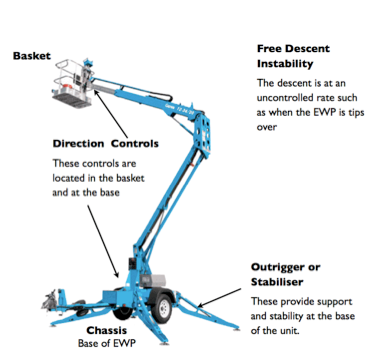
An EWP can be understood as having two parts:
• The carrier or chassis
• The elevating platform, the most common are:
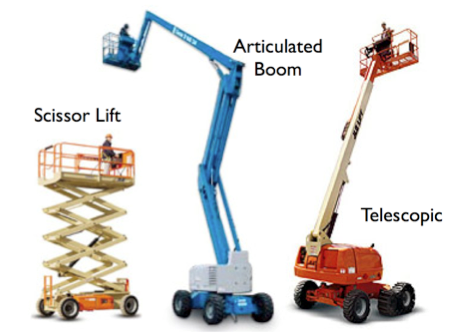
Telescopic – A telescopic boom has a straight boom and can only extend straight to the height designed.
Articulated Boom – An articulating boom allows the user to extend up and over an obstacle to reach the needed working height.
Scissor lift – A folding criss-cross “X” pattern in its design provides an up and down motion. The platform may also have an extending “bridge” to allow closer access to the work area, because of the inherent limits of vertical-only movement. The scissor lift can be moved whilst elevated from the platform itself.
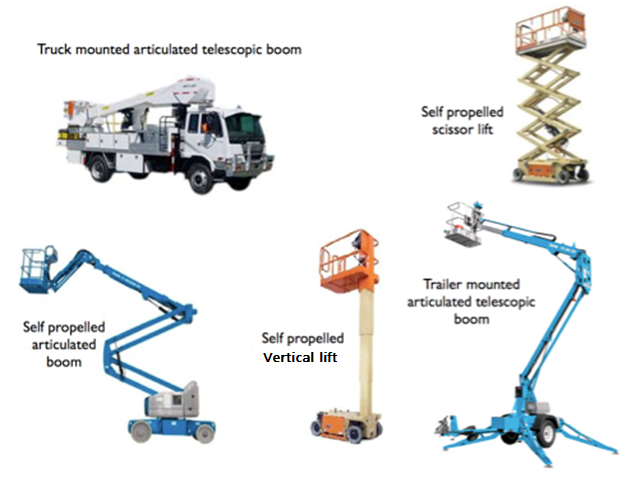
EWP Combination
The most common combinations are:
• Trailer mounted telescopic and/or articulated boom
• Truck mounted telescopic and/or articulated boom
• Self-propelled telescopic and/or articulated boom
• Self-Propelled scissor lift
Operators working on an EWP must wear a safety harness. The harness must arrest the fall before the user strikes the ground.
Tools and equipment that may be required in order to operate an EWP include logbooks, service and operation manuals, safety harnesses and lanyards. There may also be special attachments installed if equipment has to be shifted with the EWP. You are not allowed to lift loads with an EWP using ropes or cables – that is not what they were built for.
The following list can be used to develop pre/post and operational checklist. They can also be used in developing the work method statements or job safety analysis